How to Get Your Products Recommended by ChatGPT
TODD PIECHOWSKI · AUG 06, 2026 · 7 MIN READ
Most advice on this starts with a theory about how AI works. Let’s start with what it reads instead.
Between June and August 2026 we logged 1,308,790 citations sitting behind ChatGPT™ product answers, across 58 brand categories and 38,540 domains. Every time the model recommended something and showed its source, we wrote it down.
Here are the top ten domains, as a share of all 1.3 million.
| Domain | Share |
|---|---|
| reddit.com | 3.75% |
| allure.com | 2.43% |
| goodhousekeeping.com | 1.73% |
| healthline.com | 1.73% |
| nbcnews.com | 1.73% |
| youtube.com | 1.68% |
| google.com | 1.45% |
| forbes.com | 1.19% |
| consumerreports.org | 1.03% |
| glamour.com | 1.02% |
And then there’s Amazon.
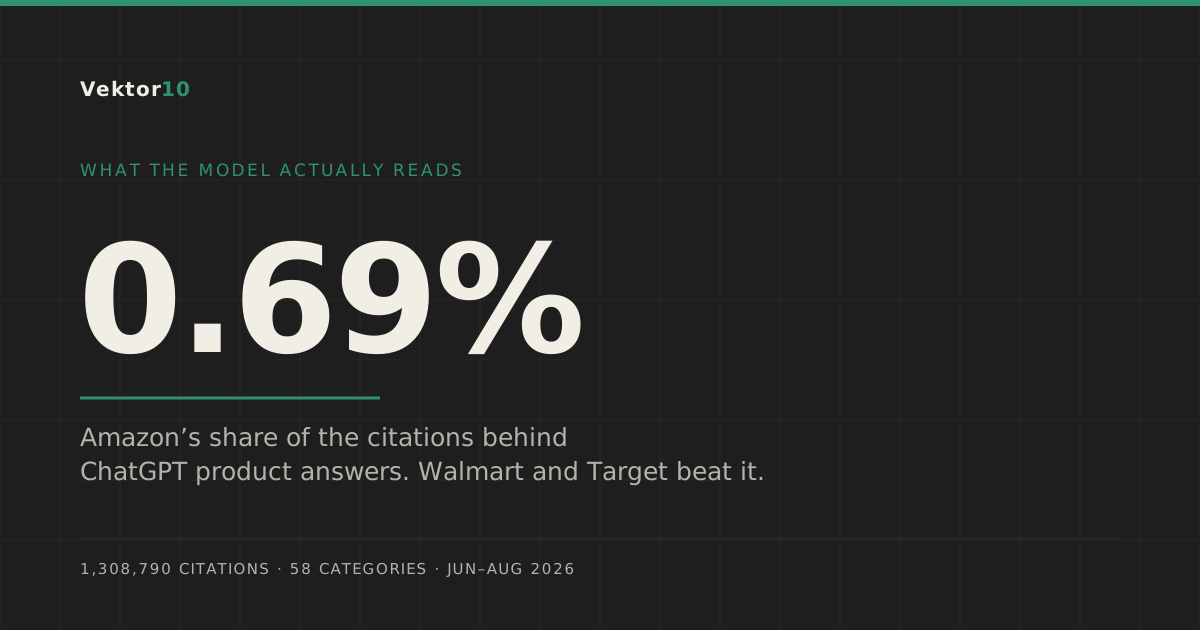
Amazon is 0.69%. Walmart is 1.08%. Target is 1.00%. Both of them get cited more often than Amazon when ChatGPT™ recommends a product. Every major retailer we track — Amazon, Walmart, Target, Ulta, Chewy, Sephora, Best Buy, Costco — adds up to 4.95% combined. Reddit alone is most of the way to that on its own.
If your AI strategy is “we’re strong on Amazon, so we’ll be fine,” that’s a problem. The place where you’ve spent a decade building reviews and rank is a rounding error in what the model reads to form an opinion.
What this means, concretely
Two jobs, and people usually only do the second one.
Job one: be in the sources. The pages ChatGPT™ reads are editorial roundups, health and beauty publications, forums, and video. Not your PDP, not your Amazon listing. If Allure’s “best serums” piece doesn’t have you and Good Housekeeping’s doesn’t either, you’re not in the raw material — no amount of on-site work fixes that.
This is old-fashioned work. Get sampled by the publications that run roundups in your category. Give reviewers a reason to include you. Show up in the subreddit where people actually ask, without astroturfing it, because that gets caught and it’s a bad look.
Job two: be correct when it checks. Once the model has a candidate set, it verifies. Price, availability, whether the thing can actually be bought. This is where most brands quietly fail, and it’s the half that’s fully under your control.
Feed accuracy. GTINs that match. Prices that match what’s on the page. Structured data on the product page that says what the product is. Merchant enrollment where the surface supports it. None of it is interesting work, and it decides whether you’re a name in a list or a product with a buy button.
The specific failures we keep finding
Same handful, over and over. We’ve published shelf studies on eighteen categories now — coffee, creatine, deodorant, dog supplements, olive oil, laundry detergent, sunscreen, toothpaste and ten more — and the failure list barely changes from one to the next.
Price disagreement. The feed says one thing, the page says another. The model reads both and gets cautious.
Missing identifiers. No GTIN, no MPN, or a made-up one. The product can’t be matched to anything else known about it.
A product page a crawler can’t read. Server-render it. If the description only exists after JavaScript runs, assume it doesn’t exist.
Nothing that answers the buying question. Your page says what the product is. The shopper asked which one is better for sensitive skin, or whether it fits a 10-inch pan. If nothing on your site answers that, nothing gets quoted.
Robots.txt blocking the AI crawlers. Still surprisingly common, usually set years ago by someone who’s gone. Check yours today; it takes a minute.
What doesn’t work as well as people hope
Publishing volume. Content helps get you into the source pool, but the correlation between how many pages a brand has and how often it gets recommended is weak in every dataset I’ve seen, including ours. Ten pages that answer real buying questions beat two hundred that don’t.
Chasing your own brand name. A brand-name question mostly tells you the model can read your website. The question that matters is the one where nobody’s brand name appears. We audited our own agency this month: a perfect 41 out of 41 on brand-name questions, zero out of 86 on the ones where a buyer describes a problem — and when we actually read those 41, only 12 were describing our company at all. Same company, same week.
Assuming rank. There’s no position one here. The same question asked five times returns different products in a different order. Measure how often you appear across repeats, not where you sat once.
How to check your own, this week
You don’t need us for this part.
- Write down ten questions a stranger would type to find a product like yours. No brand names in any of them.
- Ask each one five times in a fresh chat. Five, because one answer is noise.
- Count how many of the fifty answers name you. That fraction is your number.
- Open the sources ChatGPT™ cites and note which domains keep coming back in your category. That’s your target list for job one.
- Then check the boring things: robots.txt, feed price versus page price, whether your PDP renders without JavaScript.
Most brands doing this for the first time land somewhere between zero and ten percent, and find at least one broken thing in step five. Both results are useful.
The honest caveat
This is one engine at one moment. ChatGPT™ is where the volume is today, and it’s what our numbers cover, so it’s what we’ll claim. The citation mix moves — Amazon’s share in our data is meaningfully different now than it was earlier this year, and I’d expect the retail share overall to climb as more of these surfaces strike commerce deals.
What seems durable is the shape of it: the model forms an opinion from what other people wrote about you, then checks your data before it recommends you. You can influence both, and you can’t buy either one.
Method: 1,308,790 citations logged from ChatGPT™ product answers across 58 brand categories and 38,540 domains, 1 June – 7 August 2026. Domain shares are the percentage of all logged citations. Excludes our own agency-category audit, which is a separate study. Retail group = Amazon, Walmart, Target, Ulta, Chewy, Sephora, Best Buy, Costco.