I Ran Our Own Audit. ChatGPT Has Never Heard of Us.
TODD PIECHOWSKI · AUG 06, 2026 · 7 MIN READ
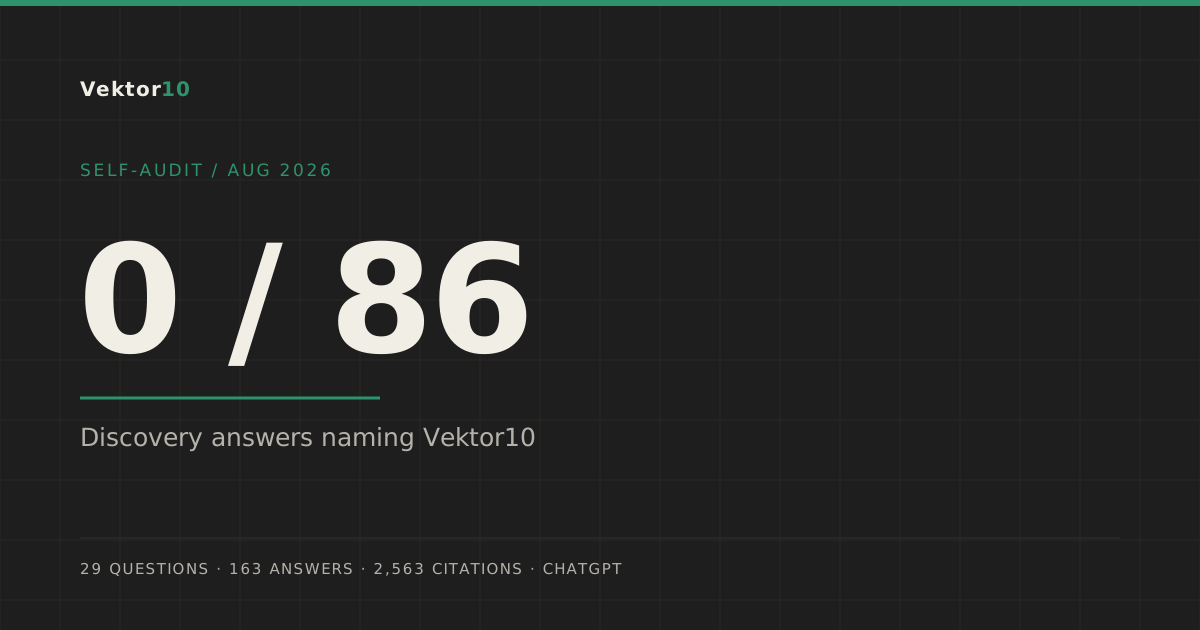
We sell AI visibility. So this week I pointed our own probe at our own company.
Same rig we run for clients. 29 questions, five runs each, ChatGPT™ only. 163 answers came back, with 2,563 citations behind them across 602 domains. Nobody put a thumb on the scale, and I didn’t get to pick the questions after seeing the results.
Here’s the whole thing, including the part that stings.
The half I read wrong the first time
Our own tooling said we scored 41 out of 41 on brand-name questions. Perfect score. I nearly wrote that down as the good news.
Then I read the answers.
Twelve of the 41 actually describe Vektor10. Eighteen describe a different company — Vector 10, spelled with a c, a textile innovation consultancy that helps brands commercialize fabric technology. The remaining eleven can’t identify anything at all.
Verbatim, to the question “Is Vektor10 legit?”:
If you mean Vector 10 / V10 (the textile innovation consultancy), I found a company website describing textile manufacturing and sustainability consulting services.
So 29% right, 44% a company in an unrelated industry, 27% a shrug.
The 41 out of 41 was true and useless. The flag counts whether the string “Vektor10” shows up in the answer, and the sentence “I couldn’t find a company called Vektor10” contains it. Recognition and confusion score identically.
Which is an uncomfortable thing to publish when you sell measurement, so let me be blunt about it: I built the metric, I misread my own output, and the mistake ran in the direction that flattered us. That’s the direction these mistakes usually run. If you take one thing from this post, take that — the number has to be checked against the raw answers, every time, including by the people who built it.
Comparison questions are cleaner but not clean: of 36, 15 are right and 7 describe the textile firm.
The name collision is fixable and it’s on us. Nothing about our site tells a model that Vektor10 and Vector 10 are different companies, and we’ve never published anything that disambiguates them.
Now the questions that pay the bills.
The half that matters
Sixteen questions. The ones a brand types when they’ve never heard of us and have a problem:
- “What are the best AI search optimization agencies for ecommerce brands?”
- “Who can optimize my product feed so my products show up in ChatGPT™ shopping results?”
- “I run a $20 million DTC brand and my Google traffic is dropping because of AI answers. Who should I hire?”
- “Which agencies help beauty and supplement brands get picked by AI assistants?”
86 answers across those sixteen questions.
We appear in zero of them.
Not buried at the bottom. Not “mentioned but ranked poorly.” Zero. I checked it four ways before I believed it — the name, the misspelling with a c, both co-founders’ surnames, the bare domain. Nothing, on any of them.
Closing that exact gap is what we charge people for.
Who’s in the room instead
133 other firms got named across those 86 answers. Here’s the top of it — the percentage is how many of the 86 answers named each one.
| Firm | Share of answers |
|---|---|
| Siege Media | 24.4% |
| iPullRank | 23.3% |
| Animalz | 19.8% |
| NP Digital | 18.6% |
| Single Grain | 15.1% |
| Semrush | 12.8% |
| Otterly AI | 10.5% |
| First Page Sage | 10.5% |
| Omniscient Digital | 10.5% |
| Ahrefs | 10.5% |
| Publicis | 10.5% |
| WRKNG Digital | 9.3% |
| Profound | 8.1% |
| NoGood | 8.1% |
| Scrunch | 8.1% |
| Vektor10 | 0% |
The most-named firm in the entire category shows up in fewer than one answer in four. There’s no incumbent here. Nobody has this locked.
Further down: WRKNG Digital at 9.3%, a firm I’d never heard of before I read my own data, sitting above Profound — which has raised real money and is the name everyone in this space knows. The tail runs a hundred deep with agencies nobody has heard of, all of them getting named on the questions where we get nothing.
So the bar isn’t authority, and it isn’t funding or headcount or how long you’ve been around.
So what is the bar
I re-cut all 1,258 citations behind those sixteen answers by who owns the page.
| Who owns the page | Share of citations |
|---|---|
| Vendors — agencies and tools, their own sites | 62.8% |
| Reference — research papers, docs | 16.2% |
| Editorial — press and trade | 11.6% |
| Forums | 5.2% |
| Directories | 4.1% |
Nearly two thirds of what ChatGPT™ reads to answer “who should I hire” comes off the marketing sites of the firms competing for the job. 295 separate vendor domains. They wrote the page that recommends them, and the model read it.
Some of these are exactly what you’d guess. First Page Sage publishes “The Top Ecommerce GEO/AEO Agencies.” The Growth Syndicate publishes “Top 11 ChatGPT™ Ads Agencies in the US” and ranks itself first. I pulled that one up to check — we’re not on it, and neither is anyone who didn’t pay attention to the format.
Two other things in that data surprised me.
A research paper is the single most-cited URL in the category. One arXiv preprint got pulled into 31 citations across 10 of the 16 questions. arxiv.org overall: 96 citations. More than any agency, any tool, any trade publication.
One Reddit thread carries 5.2% of everything. A single r/Superframeworks post — “10 Best AI SEO GEO/AEO Agencies for 2026” — reached 15 of the 16 questions. One forum domain, more citations than the entire directory category including Clutch.
Our own site, by question type
Citations pointing at vektor10.com, split by what was asked:
- Brand-name questions: 7
- Comparison questions: 13
- Discovery questions: 0
We have 121 URLs indexed. 96 of them are the AI Shelf Index — real measured research on other people’s categories, which I’m proud of and which is doing nothing for this. Ten blog posts. One case study.
When someone asks ChatGPT™ who to hire, it reads 364 domains and not one of them is ours. We wrote a lot of pages. We never wrote that one.
What I’m actually doing about it
Not a plan. Four things, starting with this post.
Publish the measurement, not the opinion. This piece is the first one. The category is full of agencies asserting they’re the best; almost none of them show their work. We have the probe. We’ll keep pointing it at things, including at ourselves, and publish what comes back whether or not it flatters us.
Answer the sixteen questions on our own domain. Not with “ultimate guide” filler. With the data — what we measured, what it means for a brand deciding who to pay. Two of those pages went up alongside this one.
Fix the plumbing. Our structured data named one founder while the About page named two — that one went out with this post. The bigger gap is that our entire entity graph is a single LinkedIn link, which is thin for a company asking anyone to trust it with a catalog. Unglamorous work, and it’s what a model uses to figure out who we are.
Separate ourselves from Vector 10. Nothing we publish currently tells a model that the AI commerce agency and the textile consultancy are two companies. That’s our problem to solve, not theirs — they were here first and they’re not doing anything wrong.
Then re-probe in 30 days and publish the delta. If the number doesn’t move, that’ll be a post too.
Do this on your own company
If you sell something, ask ChatGPT™ for it the way a stranger would. Not by your name — by the problem. Then ask a few more times, because one answer isn’t a measurement.
You’ll get one of three results. You’re in the answer, which is worth knowing before someone else changes that. You’re not, and neither is anyone else recognizable, which means the category’s still open. Or you’re not and a hundred firms you’ve never heard of are, which is where we landed.
Then ask about yourself by name and actually read what comes back, rather than trusting a tool that counts whether your name appeared. That’s the step that found the textile company.
That last one is the annoying result, and it’s the one I’d rather have than the alternatives, because reputation clearly isn’t what’s gating it. Those hundred firms didn’t out-earn us. They published something on the question and we didn’t.
Method: 29 hand-written questions, five repeats each, ChatGPT™ only, probed 5–6 August 2026. 163 answers, 2,563 citations, 602 domains. Discovery questions are the sixteen where the buyer names no company. “Named” means the firm appears in the answer text; percentages are the share of the 86 discovery answers naming that firm. The right/wrong-entity split on brand questions was done by reading all 41 answers and classifying each as describing Vektor10, describing another company, or failing to identify one — the string-match flag scores all three as a hit, which is the point of that section. Three questions returned extra repeats after network retries, so per-question rates are computed on their own denominators. One point in time, one engine — a re-probe will move these numbers.