What AI Search Visibility Actually Costs
TODD PIECHOWSKI · AUG 06, 2026 · 6 MIN READ
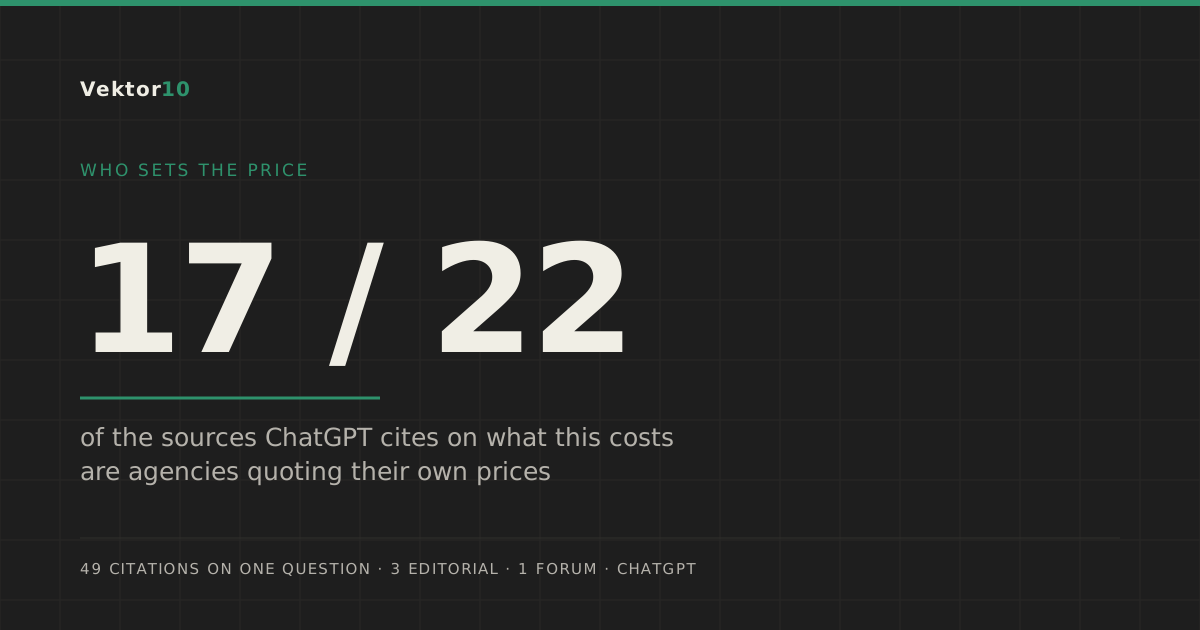
Pricing in this category is a mess, so we measured that too.
As part of auditing our own agency, one of the questions we ran was the one every buyer eventually types: how much does it cost to hire an agency for AI search visibility? Five times, ChatGPT™, same as the rest.
The answers were confident and consistent. Then we looked at where they came from.
49 citations across 22 domains. 17 of those 22 are agencies and tools quoting their own prices. Three were press — TechRadar, The Verge, one trade outlet. One was a research paper. One was Reddit.
So when a buyer asks an AI what this should cost, the number comes back almost entirely from the people selling it. Nobody’s lying. It’s just circular, and worth knowing before you treat the output as a market rate.
Here’s what it says anyway.
The range ChatGPT gives buyers
| Engagement | What it quotes |
|---|---|
| One-time audit | $1,500 – $5,000 |
| Small business retainer | $2,000 – $5,000 / month |
| Mid-market program | $5,000 – $10,000 / month |
| Enterprise | $10,000 – $25,000+ / month |
| Implementation / setup fee | $8,000 – $25,000 |
Having sat on both sides of a lot of these conversations, the mid-market band is roughly right. The enterprise band is real but usually includes a pile of content production. The audit band is high for what most audits are, and I’ll come back to that.
The setup fee is the line I’d push on. Some of it is legitimate — a genuine feed rebuild or a structured-data pass across a big catalog is real work with real hours. A lot of it is a retainer’s first three months collected up front. Ask what specifically gets delivered for it, and ask what happens to that deliverable if you cancel in month four.
What actually moves the number
Four things, roughly in order of how much they matter.
SKU count. The single biggest driver for a product brand, and the one most quotes are secretly built on. Auditing and fixing feed data for 80 SKUs is a different job from 8,000. If a firm quotes you before asking how many products you sell, they’re quoting a template.
How many questions get tracked, and how often. Measurement has a real marginal cost — every question, every repeat, every engine is a metered API call somewhere. A program tracking 300 questions daily costs meaningfully more to run than one tracking 30 weekly. This is also where cheap offers hide: they cut repeats until the number is noise.
Whether anyone does the work. There’s a wide gap between a dashboard with a login and a team that rewrites your product data, fixes your feed, and gets you into merchant programs. Both get called “AI visibility.” One is software pricing, the other is agency pricing, and the second is several times the first for the obvious reason.
How broken things are at the start. A brand with clean feeds, GTINs, and server-rendered product pages needs a fraction of the work of one whose catalog has been through three replatforms. You usually can’t know this before someone looks.
Where the money is badly spent
Buying a tracker and nothing else. Standalone visibility platforms run from a few hundred to a few thousand a month, and they’ll tell you accurately that you’re not showing up. If nobody’s funded to act on it, that’s a subscription to bad news. This is the most common waste I see.
Content retainers priced by post count. “Six AEO-optimized posts a month” is an SEO retainer wearing a new hat. For a product brand the lever is mostly catalog data, and posts don’t fix a price mismatch between your feed and your page.
Paying for engines nobody can actually read. If a proposal covers ChatGPT, Claude, Gemini, Copilot and Perplexity at a mid-market price, ask how each one is queried. Some of those don’t have a workable path for this at any price right now, which means part of the coverage is estimated.
What a fair audit costs
Somewhere between nothing and a few thousand, and the difference is entirely whether a human reads the output.
An automated scan that checks your robots.txt, schema and feed and emails you a score should be free or close to it, because it costs the vendor almost nothing to run. We give ours away for that reason. A real audit — a hand-written question set for your category, enough repeats to be a measurement, someone reading the answers and telling you what’s wrong — takes days of work and gets priced like it.
If you’re paying four figures for something a script generated, you overpaid. If you’re getting a hand-built question set and a read of the results for free, someone is hoping it turns into a retainer. Both of those are fine as long as you know which one you’re looking at.
Why we don’t publish a rate card
Honest answer: because the SKU-count and how-broken-is-it variables swing the real number by more than the range would be useful, and a public price would have me quoting either a fiction or the top of the band.
What I’ll commit to publicly is the shape. We price as a monthly retainer, scoped to catalog size and how many questions we’re tracking. We don’t charge a separate implementation fee. The measurement question set is fixed at the start and handed over, so it can’t be tuned mid-engagement to make the reporting look better. And the discovery work that tells you whether any of this is worth doing is free, because it’s the only way either of us finds out.
If the honest answer for your business turns out to be “not yet,” that’s a real outcome and I’d rather say it in week one.
Method: the pricing question was one of 29 in our own service-brand audit, run five times through ChatGPT™ on 5–6 August 2026. 49 citations across 22 domains on that question alone. Page ownership classified per domain: 17 vendor, 3 editorial, 1 reference, 1 forum. The quoted ranges are what ChatGPT™ returned to buyers, not our prices.