When You Show Up on the AI Shelf, Who Controls the Card?
TODD PIECHOWSKI · JUN 21, 2026 · 5 MIN READ
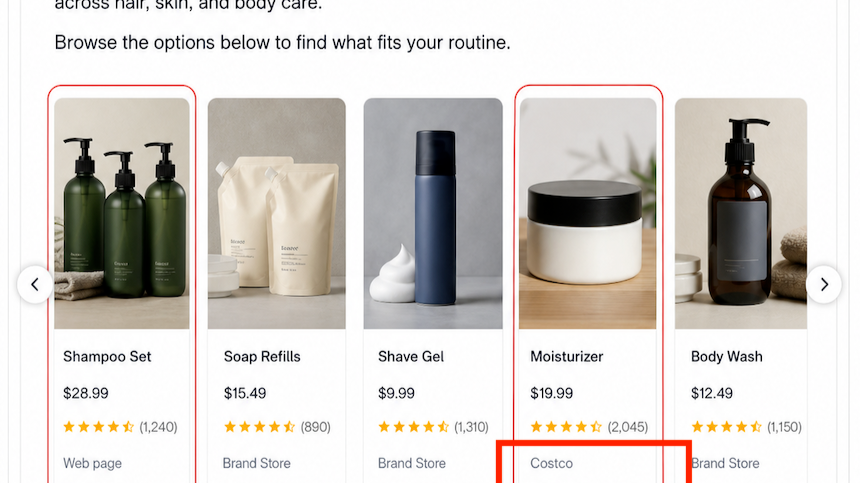
Last week we pulled up a personal care brand inside ChatGPT shopping. First look, it seemed to be in great shape. Forty of its products were in the product carousel. Broad coverage, strong presence, the thing most brands are chasing right now.
Then we looked closer.
One of the brand’s hero products — a set that drives a real chunk of the basket — had no product feed behind it. ChatGPT had grabbed it off some web page it found, with whatever price, image, and link happened to be sitting there. Not the brand’s feed. Not a source the brand controls.
A few cards over, the brand’s moisturizer was showing up too. Also not through the brand’s feed. It was there because Costco’s feed put it there. The card sends the shopper to Costco.
So the brand was winning visibility and losing control of the sale at the same time. Getting picked by ChatGPT and controlling what the shopper sees turn out to be two separate things.
The shelf isn’t as invisible as people think
Most people treat ChatGPT shopping as a black box. OpenAI doesn’t hand brands a dashboard explaining why a product appeared or which feed powered it. Fair enough. But the output leaves clues.
Every product card carries a buy link. That link often has a marker on it — something like utm_medium=feed — which tells you the product came through a commerce feed instead of a random crawl of the open web. And the card names the merchant it’s sending the shopper to. Sometimes that’s the brand’s own store. Sometimes it’s Walmart, Target, or Costco.
Read those two things together and you can start sorting the carousel, card by card.
Four ways a product can show up
Go product by product and almost everything lands in one of four buckets.
- On the brand’s own feed — brand store, brand link, brand price, brand-controlled data.
- Through a retailer’s feed only — it’s there, but it’s Costco or Walmart or Target putting it there.
- With no feed at all — ChatGPT is leaning on a scraped page, so price, link, and availability are whatever the crawler found.
- Not showing up.
For this brand, 36 of the 40 visible products came through its own feed. Ninety percent coverage. On paper, a clean result.
But the average hides the problem. The four products outside that 90% weren’t random long-tail SKUs. One was a hero product, represented by a scraped page. Another’s only path to purchase ran through Costco. The money products were the ones the brand didn’t control.
Scraped data is the part that should worry you
Retailer-led visibility isn’t automatically bad. Scraped visibility is the riskier one.
When ChatGPT surfaces a product with no reliable feed behind it, it pulls from whatever it found online — an old price, a stale image, a discontinued page, a link the brand would never choose. The shopper can’t tell the difference. The card looks official, the AI gives it credibility, and the brand never confirmed a word of it.
That’s a different animal than search. On Google a stale page might rank. In ChatGPT shopping, that stale page can become the product card.
Retail distribution works differently here
Brands have sold through Costco, Walmart, Target, and Amazon for decades. Retailers have always shaped price and presentation. None of that is new.
What’s new is how narrow the moment is. In a store, the shopper sees a shelf — your product next to alternatives, packaging, context, a real choice. In ChatGPT shopping the shopper often sees one card. One merchant. One price. One way to buy.
If Costco owns that card, Costco owns the moment. Costco sets the price the shopper sees, takes the transaction, keeps the customer, and becomes the reorder path. The brand still made the wholesale sale, but it handed over the presentation, the data, and the relationship.
That can be completely fine. If you want Costco to own that path, there’s no problem — distribution is doing its job. The trouble is finding out by accident. There’s a big gap between choosing that and discovering your best products are being represented by someone else’s feed.
What to actually check
You don’t need a full catalog audit on day one. Start where the money is. Pull your top 20 products by revenue and look at how each one shows up in ChatGPT shopping.
For each: Is it there at all? Is the card running off your feed, a retailer’s feed, or nothing? Is the price right? Is the merchant the one you’d want? Is the link one you’d actually send a shopper to?
If a hero SKU is showing up with no feed behind it, the fix is usually boring, not strategic — a missing product ID, a failed image, a stuck out-of-stock flag, a bad URL, a product dropped from the feed by accident. If a product only shows up through a retailer, decide on purpose whether that’s the plan. If it is, line up the pricing. If it isn’t, get your feed working so you have a shot at owning the card.
And stop reading the average. “Feed coverage is 90% live” sounds great and tells you nothing about whether the products that pay the bills are controlled. Nobody needs every long-tail SKU perfect by Monday. You do need your money products represented right.
This keeps moving
One caveat. ChatGPT shopping is probabilistic. The carousel can shift from one query to the next, so a product appearing once isn’t cause for panic — and a product appearing consistently across repeated prompts is a much stronger signal. Treat it as a standing check, not a one-time setup. Feed coverage drifts, inventory changes, retailer feeds update, and the shopping experience keeps evolving.
The brands that win here won’t be the ones asking “are we showing up?” They’ll be asking the harder one: when we show up, who controls the card?
Visibility is the first fight. Control is the second.